Topology Optimization

Topology optimization of a C-clip

Material property: Young Modulus: 210GPa

geometry of C clip
Load of 100MPa is applied
Mesh: Element type S4R
Element Shape: Quad ; Algorithm: Medial Axis
Approximate Global Size: 2.5

Deformed Shape
Deformed Shape

Optimization Task:

Optimization task: Freeze load regions

Design Response: Strain Energy and Volume

Objective Function: Strain Energy

Constraint: Volume(30%)

Optimization is run for 25 cycles.

Optimized Shape

Topology Optimization of a rectangular plate:

Geometry of rectangular plate: L-200 B-200 T-5
Material property: Density: 7.85e-6
Modulus of elasticity: 2.1e5, Poisson’s ration: 0.3

What is a Carbon Nanotube?

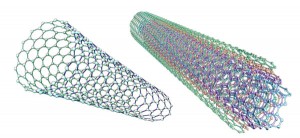
nanotube-single_multi

Single- and multi-walled carbon nanotubes.

Considered one of the strongest materials known to man, carbon nanotubes possess unique structural and electrical properties that make them ideal for a wide variety of applications. Carbon Nanotubes come in two principal forms, single-walled carbon nanotubes (SWCNT) and multi-walled (MWCNT), as pictured here. Although not a hollow tube, carbon nanofibers (CNF) represent a third type of tubular structure.

A SWCNT is on the order of one nanometer, 50,000 times smaller than the diameter of a human hair, but up to several microns long. Conceptually, a SWCNT is a one-atom-thick layer of graphite, called graphene, wrapped into a seamless cylinder with either open or closed ends. As their name implies, MWCNTs consist of multiple concentric layers of graphene that form a tube shape.

SWCNTs have unique properties that make them a vital foundation for advancing device performance because they:

  • Behave as a semi-conductor or metal
  • Are stronger than steel, yet lighter than aluminum
  • Conduct heat most efficiently
  • Can easily be modified to tailor properties as an “Ink”

Due to their unique features, SWCNT form the basis for key electronic applications such as memory, semiconductor components and transparent conducting films for touch screens, displays, solar cells, sensors and other devices.

Thermoset and Thermoplastic Composites … What’s the Difference?

As composites continue to be adopted in more industries, fiber-reinforced plastics can be found in products that people interact with every day, including cars and sporting goods. Fiber-reinforced plastics consist of reinforcing fibers surrounded by a plastic matrix. There are several types of fibers that can be used including glass, carbon fiber, and aramid which give the material its high tensile strength. The matrix gives the composite the compressive strength and, in the case of fiber-reinforced plastics, can be made using thermoset or thermoplastic polymers.

Thermoset polymers are polymers that are cured into a solid form and cannot be returned to their original uncured form. Composites made with thermoset matrices are strong and have very good fatigue strength. They are extremely brittle and have low impact-toughness making. They are commonly used for high-heat applications because the thermoset matrix doesn’t melt like thermoplastics. Thermoset composites are generally cheaper and easier to produce because the liquid resin is very easy to work with. Thermoset composites are very difficult to recycle because the thermoset cannot be remolded or reshaped; only the reinforcing fiber used can be reclaimed.


Thermoplastic polymers are polymers that can be molded, melted, and remolded without altering its physical properties. Thermoplastic matrix composites are tougher and less brittle than thermosets, with very good impact resistance and damage tolerance. Since the matrix can be melted the composite materials are easier to repair and can be remolded and recycled easily. Thermoplastic composites are less dense than thermosets making them a viable alternative for weight critical applications. The thermoplastic composites manufacturing process is more energy-intensive due to the high temperatures and pressures needed to melt the plastic and impregnate fibers with the matrix. The energy required makes thermoplastic composites more costly than thermosets.

Brittle and Ductile Fracture

Some materials are known as brittle because a crack moves easily through components made of such materials. If we investigate a fractured surface of a brittle failure to determine the depth up to which the material is affected by the crack growth, we find that material was influenced to a very shallow depth. Rest of the material remains unaffected. On the contrary, a ductile fracture causes a large amount of plastic deformation to a significant depth.

Brittle fracture in crystalline metals can be classified into two broad groups-intergranular and transgranular. A crack tip of intergranular failure grows along the grain boundaries. Transgranular fracture, on the other hand, occurs through the crack tip propagating within grains. However, cleavage failure within a grain occurs along a weak crystallographic plane. In fact, cleavage fracture is the most brittle form of a fracture and it hardly damages the fractured surfaces. Once the cleavage crack reaches the grain boundary, it finds another favorable orientation in the next grain.

Generally, at lower temperature grain boundaries have more strength than the grains i.e. grains are weaker,so fracture occurs through grains(Transgranular fracture). At high-temperature grain boundaries are weaker regions so fracture occurs through these(Intergranular fracture). There is a particular temperature at which transgranular fracture changes to intergranular fracture, this temperature is known as equicohesive temperature.

Ductile fracture growth occurs due to substantial plastic deformation and creation of microvoids in the vicinity of the crack tip. The material deforms plastically due to micromechanisms, such as nucleation and motion of dislocations, the formation of twins, etc. Engineering materials generally contain second phase particles. Tiny voids are formed at the sides of these particles under the influence of the tensile field of the crack tip. Dislocation motion helps in the formation of these voids. The ductile crack growth occurs by the coalescence of these voids. Fractured surface of a ductile failure shows tiny dimples and gives the surface a rather rough look. In fact, around one such dimple, a second phase particle can be identified. The plastic deformation and coalescence of voids absorb a large amount of energy and, therefore, a crack does not grow easily in ductile materials.

Often it has been found that materials normally ductile at room temperature in ordinary conditions behave as brittle materials under certain special conditions. Steel, which is quite ductile at room temperature, becomes brittle at low temperatures. This explains why welded structures of Liberty ships in World War II failed in the cold waters of the North Atlantic Ocean. Also, the toughness of certain materials is affected considerably by the rate of loading (strain rate).
A thick plate of a regular ductile material may also allow the growth of a crack in a brittle manner. The portion that is deep inside the thick plate (away from free surfaces) is constrained from all sides and large plastic deformations are not possible in the vicinity of the crack-tip. In comparison to thick plates, thin plates are more resistant to to crack growth.

The ductile-brittle transition temperature

The ductile-brittle transition temperature is the minimum temperature in which a given material has the ability to absorb a specific amount of energy without fracturing.

At low temperatures some metals that would be ductile at room temperature become brittle. This is known as a ductile to brittle transition.

The ductile to brittle transition temperature is strongly dependent on the composition of the metal. Steel is the most commonly used metal that shows this behavior.

For some steels, the transition temperature can be around 0°C, and in winter the temperature in some parts of the world can be below this. As a result, some steel structures are very likely to fail in winter.

This occurs mainly due to the atoms present in the material. As the temperature increases, the frequency and amplitude with which the atoms vibrate increases. This causes the atoms under stress to break bonds and form new ones with other atoms(slip). This slipping of atoms is seen as plastic deformation on the external surface of the material, a common feature of ductile materials. However, below the transition temperature, the frequency and amplitude of the vibrations decreases and the atoms just break the bonds but does not slip to a new place. As there is no slip, there is very little plastic deformation before fracture, commonly known as a brittle fracture.